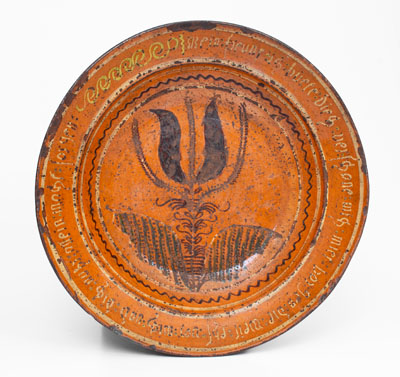
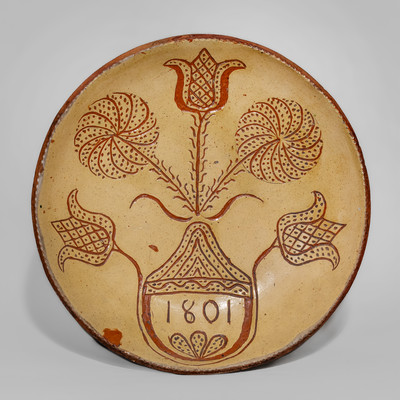
Important and Possibly Unique Redware Plate with Sgraffito Floral Motifs and Elaborate Copper Slip Decoration, Signed "MSTB / Haycock / Downship(sic) / 1794," Michael Stoneback, Haycock Township, Bucks County, PA, 1794, with coggled edge, the slip-coated interior sgraffito-decorated with a central daisy blossom bearing the inscription, "MSTB / Haycock / Downship(sic) / 1794," surrounded by additional daisies, tulips, and a diamond-shaped motif, each separated by graduated sgraffito lines. Exuberantly brushed copper slip decoration throughout including X's within the smaller daisies, slashes bordering the tulips, and crosshatched slashes bordering the central flower. Surface covered in a clear lead glaze. This recently surfaced work sheds light on an important formative period in Haycock Township sgraffito redware production from which no surviving examples were previously known. The famous potter, Conrad Mumbauer (1761-1845), apprenticed here under brothers, Michael and Henry Stoneback, during the 1790s. Mumbauer established a pottery nearby after completing his training there, and, along with John Monday (his own apprentice), would go on to produce some of the most artistic and recognizable American sgraffito-decorated redware known. This plate, bearing the initials, "MTSB," for Michael Stoneback, survives as the only signed or even documentable example of redware produced at the Stoneback pottery and is possibly the earliest dated example of Haycock Township redware known. Relatively few signed examples of 18th or 19th century American sgraffito redware by any maker have survived, a fact that puts this work in rare company. To expound on the plate's scarcity, it is also believed to be the only known example of sgraffito redware bearing a "Haycock Township" inscription. While a few Mumbauer/Monday plates include inscriptions for the owners, none mention the location of the pottery, and only one bears a signature. As noted by Christopher Malone in his article Americana Insights 2025 article, "The Potters of Haycock Mountain; Conrad Mumbauer, John Monday, and Simon Singer," "[a]ll attributions to the Mumbauer pottery are based on a single signed piece by John Monday"(Malone, p. 127). Malone continues, "[t]hough no pottery by the Stoneback brothers is known to survive, Mumbauer and his consistent aesthetic were likely influenced by his apprenticeship with them" (Malone, pp. 128-129). To this point, the tulip and daisy motifs seen on this example may have served as inspiration for Mumbauer's decorative style. The plate's exuberant brushed copper slip decoration, also seen in Mumbauer's work, appears more orderly on this example, forming unusual X's and borders around and within the flowers. The inscribed date, "1794," may hold some significance. This was the year Stoneback's brother, Henry died, as well as the year in which Mumbauer may have established his own pottery (Malone, p. 128). (Though previous scholarship on Michael Stoneback has him potting from 1793 onward, a 1781 tax listing for "Michael Stoneback, potter" in Haycock Township establishes that he was potting at least as early as that year.) As an object representing the founding of one of the most celebrated schools of Pennsylvania-German pottery, the importance of this plate cannot be overstated. Provenance: Recently discovered in New York State. Heavy chipping around plate's edge. Light wear to interior. A 5/8" reglued surface-level flake to edge of plate. Diam. 11 1/2".