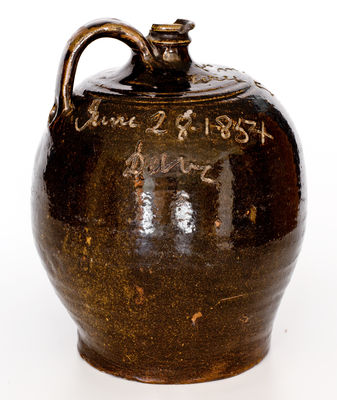
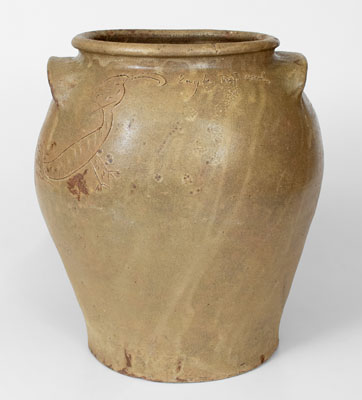
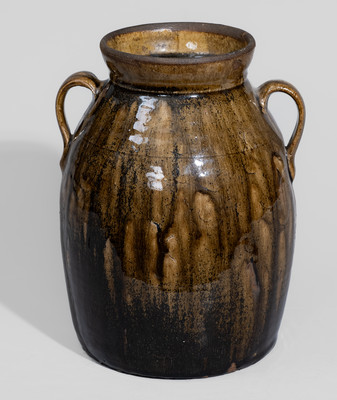
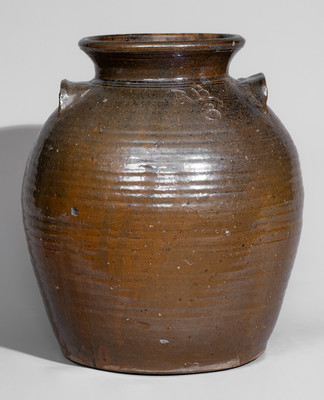
Extremely Rare One-Gallon Alkaline-Glazed Stoneware Jug, Inscribed "1 gal / Made by / Horne + Devore / Kirksey's X Roads / Edgefield Co. / S.C. / May 25-th 1874," William Horne and John Devore at the Jesse P. Bodie Pottery, Kirksey's Crossroads, Edgefield District, SC, 1874, ovoid jug with tooled spout and glossy, olive-colored alkaline glaze, featuring a lengthy incised inscription bearing the signature of cooperative potters, William Horne and John Devore, along with the pottery location, "Kirksey's X [Cross]Roads," the county and state of production, "Edgefield County / S.C.," and date of manufacture, "May 25-th 1874." This jug is only the second documented work signed by this potting duo, both employed by well-known Edgefield pottery owner, Jesse P. Bodie, in existence. Horne and Devore are discussed at the length in Cinda K. Baldwin's book, Great and Noble Jar. As noted by Baldwin, a William Horn is listed in the 1870 U.S. Federal Census as a twenty-two-year-old living at the "Kirksey's X Roads" post office with occupation of "work in Potry(sic)." Jonathan Devore, age forty-three, was listed as a farmer living next door to the Horn family. Baldwin refers to a 1920 interview with John Devore's son, William J. Devore, in which he stated that his father turned at the Roundtree and Bodie pottery directly after the Civil War until its closing. John Devore is also listed in the 1860 census as living next to W.D. Roundtree, Bodie's predecessor at the pottery, with an occupation of "overseer." This jug offers rare insight into the relationships among 19th century American pottery workers in that it indicates a cooperative effort in the production of even relatively small pieces, in this case, a jug of only one gallon capacity. Perhaps one man threw the jar and the other trimmed it and glazed it. The second known jug is a two-gallon example made only two months earlier, dated "July 30th, 1874," suggesting these special pieces may have been made within a very brief window of production. Outside of the work of David Drake, they rank among the most heavily-inscribed pieces of Edgefield stoneware known. Literature: For a related jug and discussion of these potters, see Baldwin, Great and Noble Jar, pp. 103-104. Professionally restored handle, damage common to the other known inscribed jug. Otherwise excellent condition with minor chipping to bottom edge of jug, a minor spout chip, and two minuscule spout nicks, retaining strong luster to the surface. H 14 3/8".