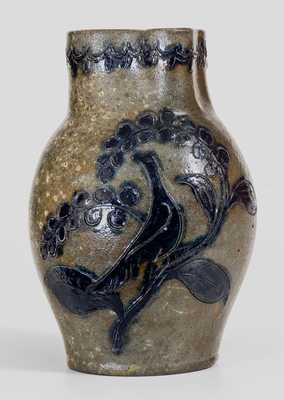
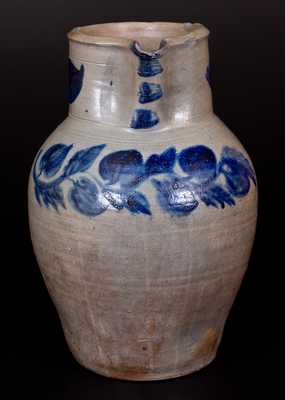
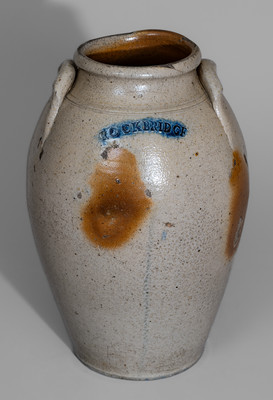
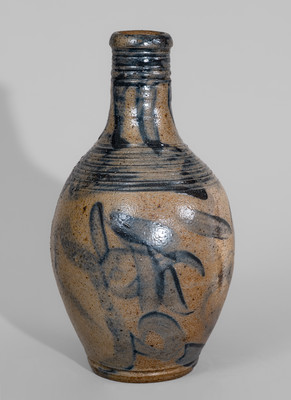
Very Rare Half-Gallon Cobalt-Decorated Stoneware Jug, Inscribed "1/2," attributed to the Richard Randolph Pottery, Four Mile Creek, Henrico County, VA, circa 1813-1821, ovoid jug with distinctive spout, brush-decorated on the front with the fraction, "1/2," denoting one-half gallon. Areas of the jug, primarily on the reverse and handle, reveal a reddish-brown iron wash. Surface covered in a clear salt glaze. As noted in Russ, Hunter, and Mueller-Heubach's Ceramics in America 2013 article, "The Remarkable 19th-Century Stoneware of Virginia's Lower James River Valley," jugs of this type, referred to as pottles, were ordered by Thomas Jefferson for holding beer made at his Monticello residence. The following excerpt is from this article: Randolph's initial 1813 advertisement announced the establishment of his "Stone Ware" factory and emphasized his "constant supply of Soda, cyder and beer bottles." Thomas Jefferson wrote to him in 1814 requesting stoneware jugs in two sizes--"quart jugs" and "pottles" (half gallons)--for his homemade beer at Monticello: "Dear Sir [Randolph] Monticello Jan. 25. 14 Will you be so good as to send me two gross of your beer jugs; the one gross to be quart jugs, and the other pottles do. they are to be delivered to a mr William Johnson a waterman of Milton, who will apply for them about a week hence. Mr Gibson will be so good as to pay for them on your presenting this letter. they should be packed in crates, or old hogsheads or such other cheap package as you use. Accept the assurance of my esteem & respect. Th: Jefferson Although he also wrote to England for beer bottles, Jefferson heard of or saw the ad for the new Four Mile operation and may have wished to favor native industry and familial ties. In fact, a second request was made in late September that year for "four gross more" jugs to accommodate Jefferson’s new brew of "malt strong beer." A recent comparison of bottle fragments recovered at Randolph’s pottery with those found at Monticello reveal matching forms with distinctive neck treatments and iron-oxide washed surfaces, confirming Randolph’s operation as their source. As this article was going to press, an intact example of a pottle was identified." Few intact examples of Randolph-made pottles are known. As noted, one was discovered while the above article was going to press. Each survives as a fascinating link to American presidential and early Southern ceramic histories. Literature: For a closely related example, see Hunter, Goodman, and Mueller-Heubach, fig. 24. Provenance: Recently surfaced in the Midwestern U.S. An in-the-firing contact mark to front including an in-the-firing chip. Spout with a small chip and wear to top edge. A minor base chip on front and a small glazed-over base chip on reverse. H 10 1/4".