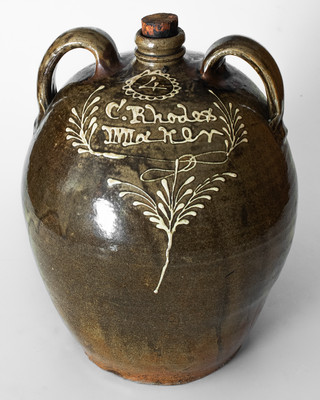
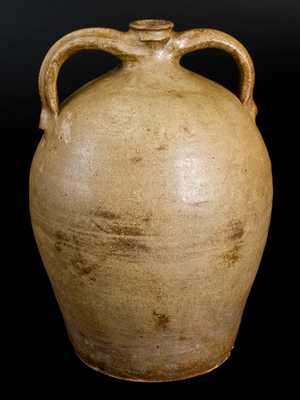
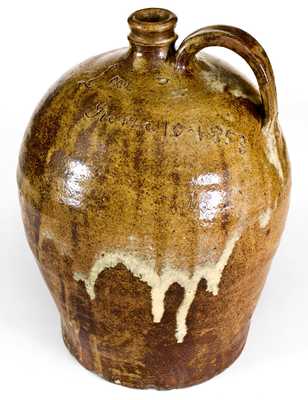
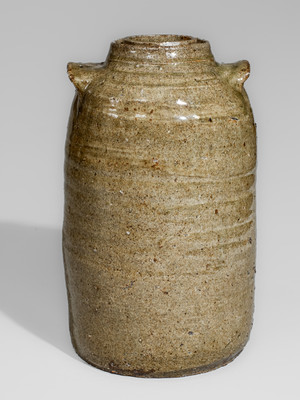
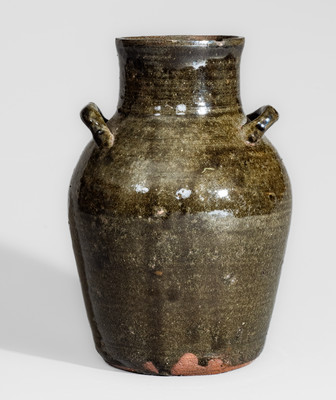
Outstanding Ten-Gallon Double-Handled Alkaline-Glazed Stoneware Jug with Iron Slip Decoration, Upstate SC or Thomas Chandler School, Martintown Road Pottery, Kirksey's Crossroads, Edgefield District, SC, or John D. Leopard, Bacon Level, Randolph County, AL, second or early third quarter 19th century, ovoid jug with tooled spout and two ribbed vertical-strap handles, applied at the shoulder, the surface covered in a streaky olive to gray-green alkaline glaze with dramatic reddish-brown iron-slip runs descending from the shoulder. Among the most beautifully-glazed Southern stoneware jugs that we have ever offered, this masterwork of mysterious origin is given five pages of illustration in Mark Hewitt's book, Great Pots from the Traditions of North & South Carolina. Various intriguing characteristics about the jug, most notably its iron slip decoration, has led to several possible conclusions as to its maker. Hewitt describes this object as follows: "No pot in this exhibition has brought me as much pleasure and consternation as this one. Pleasure because of the wonderful, etheral, dark red ochre bleeds that saturate the green ash glaze, perfectly enhancing the lovely shape and fine handles. Consternation because the question of attribution remains unsolved. Three theories prevail: It was found in Spartanburg County, South Carolina, and had been owned by the same family since before the Civil War. It could therefore be from the hand of an unknown Upstate potter. It was made in Edgefield by one of the many potters who worked alongside Thomas Chandler at the Martintown Road site in the late 1830s. However, despite a few inconclusive shards, no record of iron wash on ash glazes survives from that site. [Philip Wingard does, however, attribute pieces with iron decoration to this site in his article, "From Baltimore to the South Carolina Backcountry: Thomas Chandler's Influence on 19th-Century Stoneware".] [The third theory is that] the maker was John Leopard, who trained with Chandler in Edgefield before moving to Bacon Level, Alabama, in 1837, where he made pots that were ash-glazed and stuck with ochre nuggets on the shoulder that bled into the ash glaze during the firing, leaving iron-saturate streaks of various colors, and occasionally leaving unmelted nugget remnants of ochre, which look similar to kiln drips. Leopard would later move to East Texas and continue decorating with ochre. Perhaps Leopard made it in South Carolina after his training with Chandler and before heading to Alabama. Or perhaps it was made in Alabama, where someone spotted Leopard's beauty, and brought it back to South Carolina. We may never know, but for me, its allure is only enhanced by the mystery of its origin" (Hewitt, p. 72). Ward understandably describes this lot as the "most spectacular piece" in his collection. Combining exceptional size, form, and glaze, this currently-anonymous work reveals the hand of a master potter perhaps more interested in the art of his craft than its utility. Exhibited/Literature: Great Pots from the Traditions of North & South Carolina, North Carolina Pottery Center, May 6 - July 22, 2017, pp. 69-73 of exhibition catalog. Provenance: Originally found in Spartanburg, SC, having descended in a local family since before the Civil War. Excellent condition with only minor flaws: a small chip to one handle, a minor nick to opposing handle, light wear to interior of spout, minor surface wear to body of jug, and a faint line on underside, possibly in the firing. H 20".
Special Note: Due to this object's large size, we are unable to ship it using our normal in-house shipping service. It must either be picked up by the high bidder, or special arrangements must be made by the high bidder for pick up and / or shipping by a third party. If you have any questions, please contact us; we are certainly able to recommend options for third party shippers ahead of time that you can contact for a quote.