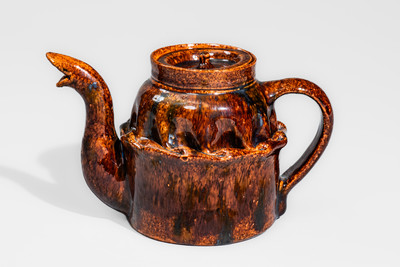
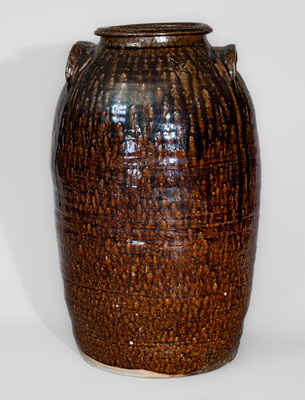
Exceptional Small-Sized Alkaline-Glazed Stoneware Ring Jug, attributed to the Jefferson S. Nash Pottery and/or Milligan Frazier near the Nash Site, Marion County, TX, second half 19th century, wheel-thrown, ring-shaped jug with footed base, applied slightly-flared spout, and arched strap handle, the surface covered in a mottled brown alkaline glaze with heavy grayish glass runs throughout, including bluish-white rutile accents. A larger ring jug with closely-related form and glaze, bearing the mark of Marion County, TX pottery owner, Jefferson S. Nash, was sold in Crocker Farm, Inc.'s November 2, 2013 auction, lot 5. Both the jug in that auction and this example owned by the Wards feature a distinctive glaze associated with African-American potter, Milligan Frazier (c. 1848-after 1910), an associate of Nash. Numerous other pieces of Texas-made stoneware with a dark-brown alkaline glaze accented with glass runs have carried strong Frazier attributions. The February 17, 1974 edition of the Longview Morning Journal, a Texas newspaper, contains an important article on this maker and his pottery. According to this source, Frazier was eventually producing ware independently at his homestead near the Nash site, known as "Milligan's Jug Works." Glass used to produce the glazes were acquired from local townspeople in the form of "old bottles, snuff jars, and blue glass bottles." The glazing process is described as follows: "First he would grind the glass into a fine powder, then mix it with powdered sand rock and water until it was like paint, then roll the pottery piece in the mixture. This finished, he would sprinkle finely ground white glass over the rim and top, thus resulting in a variance of color after the pieces were baked. Browns of varying shades, streaked with black, seemed to be the dominant colors for his works." Frazier's son, Sam, who was alive at the writing of this article and himself active at his father's shop in the early 20th century, provided this detailed information. According to Amy Kurlander in Texas Clay: 19th-Century Stoneware Pottery from the Bayou Bend Collection, Jefferson S. Nash, was an entrepreneur and planter born in Georgia in 1804. He arrived in Marion County, TX in 1846, where he established the state's first iron furnace and also a stoneware pottery. He was linked to the Edgefield potting tradition through his brother-in-law, James Gibbs, who was an investor in Edgefield's Pottersville Pottery during the 1840s. Some of the small number of surviving signed Nash pieces reveal a connection to the Edgefield style, raising the question of who worked at his pottery. Regarding who produced his ware, Nash is often discussed in connection with Milligan Frazier, who would later operate his own shop near the Nash site. As noted by Kurlander and evidenced in period documents, Frazier, along with his mother and siblings were associates of Nash. However, Sam Frazier states that his father had learned the potter's trade while living in Louisiana. Kurlander also notes that both Frazier and Nash were tied to Edgefield-trained potting families in Bienville Parish, LA, further adding intrigue to the story. Frazier was possibly too young to have worked as a potter at Nash's shop in Texas, but may have produced pieces there as a teenager or learned the glazes of Nash's shop as a child laborer, which he would use years later at his own operation. This jug's outstanding form and fine glazing, which includes the ground glass treatment that Sam Frazier describes, places it among the most significant examples of Texas stoneware to come to auction in years. Exhibited/Illustrated: Swag & Tassel: The Innovative Stoneware of Thomas Chandler, McKissick Museum, August 6, 2018 - July 20, 2019, p. 90, pl. 106 of exhibition catalog. Excellent, essentially as-made condition. H 6 1/2".