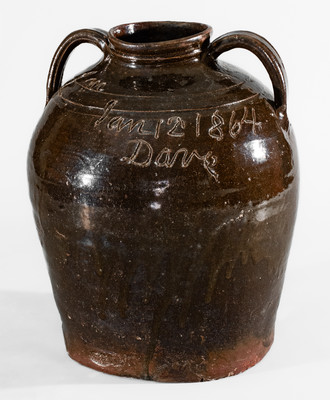
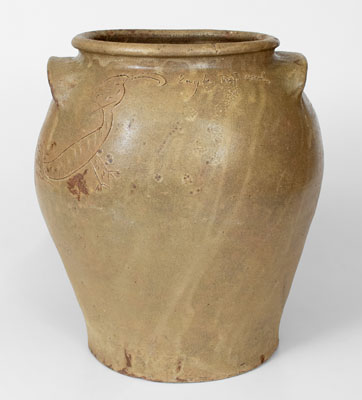
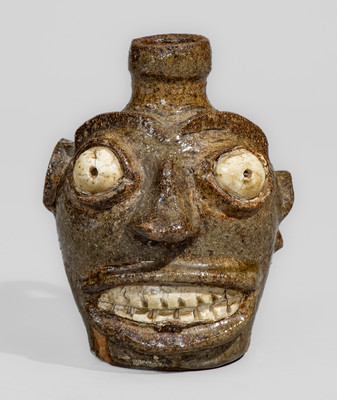
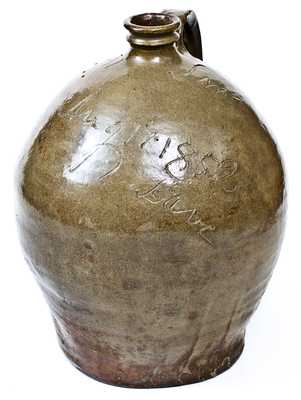
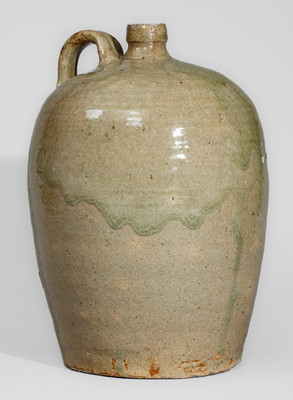
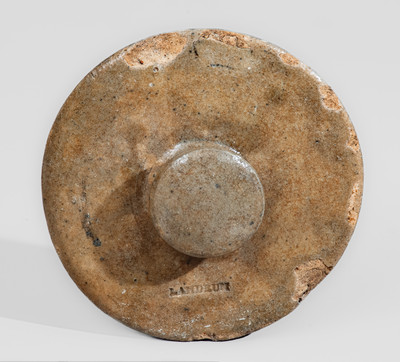
Exceedingly Rare and Important Alkaline-Glazed Stoneware Jar, Stamped "I D," John Isaac Durham, Edgefield District, SC, 1820's - 1840's, ovoid jar with semi-rounded rim, the surface covered in a grayish-tan alkaline glaze. Shoulder impressed "I D," for Edgefield potter, John Isaac Durham. According to Philip Wingard's Ceramics in America 2013 article, "From Baltimore to the South Carolina Backcountry: Thomas Chandler's Influence on 19th-Century Stoneware," Durham was the father-in-law of Thomas Chandler, who married Durham's daughter in 1838. Wingard notes that "Chandler's marriage into the Durham family. . . placed him in the midst of the primary potters at Pottersville and the Martintown Road pottery during the 1830s: Rueben Drake, John Isaac Durham, Amos Landrum, Robert Mathis, John Presley, and Collin Rhodes (Wingard, p. 51)." According to Baldwin's Great & Noble Jar, "Two of the highly skilled turners who worked at Phoenix Factory [on Shaw's Creek] were Thomas Chandler and Isaac Durham. Durham had turned ware at the Pottersville factory and came from a family of potters" (Baldwin, p. 47). Wingard further notes that Durham likely worked with Chandler at a shop on Martintown Road as early as 1837 and by 1840 the two were working together at Phoenix Factory, producing some of the most decorative ware ever made in Edgefield. Interestingly, the Durham/Chandler connection would continue decades later with the involvement of John Isaac Durham's son, Marion Jefferson Durham, and a black potter named John Chandler (the "John" previously enslaved by Thomas Chandler) at the Wilson Pottery in Guadalupe County, TX, during the 1860s. While John Isaac Durham was heavily involved in the region's stoneware industry at a number of sites, a lack of signed examples of his work has limited our understanding of his influence. Wingard notes in his article that marked sherd(s) and/or intact piece(s) bearing Durham's "I D" stamp are known, possibly referring to this specific piece. In our research, this jar is the only example of stoneware marked in this manner that we can find record of. Provenance: Purchased by the Wards decades ago at a South Carolina estate auction. Two hairlines from rim on front, measuring 3" and 2 1/2". A 3/4" hairline from rim on reverse. A hairline across underside, extending 5" up one side of jar and 3 1/4" up opposing side of jar. An additional 5 3/4" horizontal line extends through one of these vertical lines. An in-the-firing ping near midsection. H 8 1/2".