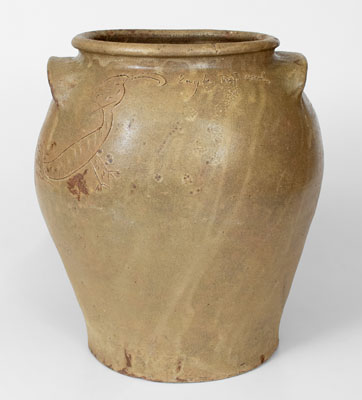
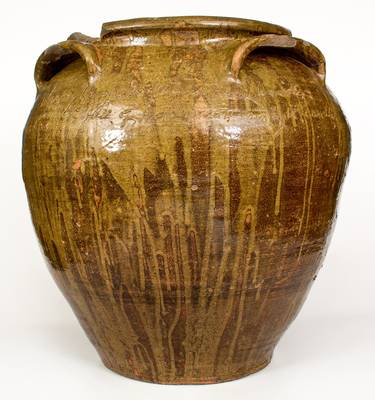
Exceptional Four-Gallon Double-Handled Stoneware Jug with Alkaline Glaze and Two-Color Slip Decoration, Inscribed "C Rhodes / Maker," Collin Rhodes Pottery, Shaw's Creek, Edgefield District, SC, circa 1843, rotund jug with tooled spout and two ribbed vertical-strap handles applied at the shoulder, decorated on one side with a large tulip composed of brushed iron slip detailed with slip-trailed kaolin slip, and on the reverse with a stylized iron-slip design with highly unusual incised treatment, described by David Ward and ceramics scholar Mark Hewitt in his book, Great Pots from the Traditions of North & South Carolina, as a butterfly. Further incised with conjoined incised numerals, which appear to be the maker's attempt at altering the gallonage from a 3 to a 4. Midsection incised with the rare script signature, "C Rhodes / Maker." As with the incised signature, the incised treatment seen on the decoration and numbers above, are also rarely seen in this pottery's products. Hewitt dedicates two large photographs to this jug in his book, describing it as a "virtuouso performance." This jug, likely made in the early 1840s, shortly after Rhodes established his own pottery on Shaw's Creek, follows the highly decorative nature of pieces produced at his previous venture, Phoenix Factory, which included two-color slip decoration and, on at least one occasion, freehand incising. Distinguished by its outstanding form, bold, two-sided decoration, and extraordinary incised signature, this jug is the finest example of Collin Rhodes stoneware that we have offered and among this factory's greatest works to ever come to auction. Exhibited/Literature: Great Pots from the Traditions of North & South Carolina, North Carolina Pottery Center, May 6 - July 22, 2017, p. 22 and 23 of exhibition catalog; Swag & Tassel: The Innovative Stoneware of Thomas Chandler, McKissick Museum, August 6, 2018 - July 20, 2019, p. 59, pl. 57 of exhibition catalog. Provenance: Purchased by the Wards at Brunk Auctions, Asheville, NC. Restoration to section of spout. According to David Ward, he found a small piece of the jug's spout inside of the jug after purchasing it and reglued it. The painted section of the spout, spanning roughly half of the jug's top molding and stopping above its lower molding, appears to cover this reglued piece and is likely excessive. Some additional spout wear and minor surface wear to body of jug. The jug's condition is considered excellent for pieces of this form and origin, which are frequently found with more significant damage or restoration, particularly to the spout and/or handles. H 16".