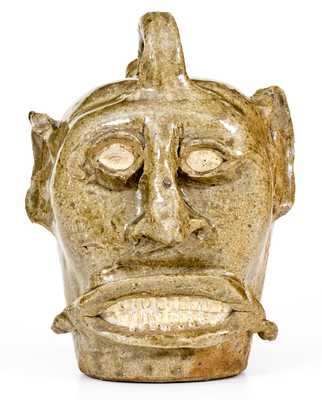
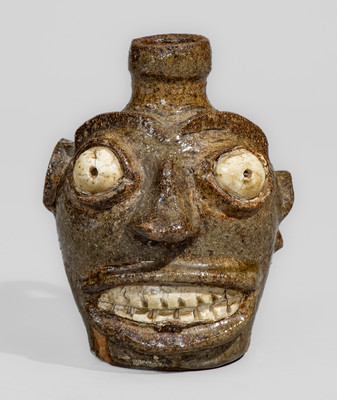
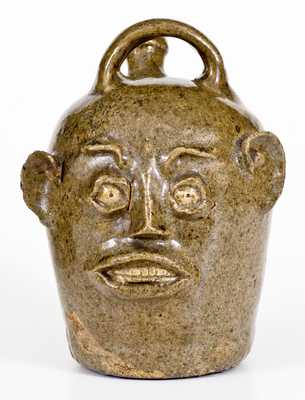
Exceedingly Rare and Important Alkaline-Glazed Stoneware Face Pitcher, Edgefield District, SC origin, third quarter 19th century, ovoid pitcher with footed base, ridge shoulder molding, flaring collar, and broad, flattened spout, decorated with a hand-modeled and applied clay face, including kaolin eyes with pierced pupils surrounded by oval lids, slightly-curved eyebrows above, nose with pronounced bridge, snubbed tip, and carved nostrils, C-scroll ears with applied tragi, open mouth with applied kaolin insert and incised teeth, and small chin below. Depressions around the mouth and along the sides of the pitcher, formed while the vessel was still malleable, create a stylized structure of the human face with prominent, bulging cheeks. As nearly all Edgefield face vessels are jugs with narrow spouts, this pitcher's wide opening offers a rare interior glimpse at this modeling. The exterior and interior surface are covered in a glossy, olive-green alkaline glaze flecked with iron. This face vessel is among the finest and most famous Edgefield examples in existence. One of only a small group of face pitchers known from the region, this work is further distinguished by its superb modeling with highly expressive face, its fine condition, and beautiful, lustrous glaze. It additionally carries an outstanding provenance, distinguished as arguably the finest of a select group owned by early collector, Helen Eve. Eve was the daughter of Colonel Thomas Davies, owner of the Palmetto Fire Brick Works of Bath, SC, an Edgefield District pottery famously mentioned in Edwin Atlee Barber's The Pottery and Porcelain of the United States as a producer of face jugs. Information in this book regarding Barber's correspondence with Davies himself has served as our earliest documentation and understanding of Edgefield face vessels. The following excerpt from Christie's The John Gordon Collection of Folk Americana catalog describes a direct link between Barber and Gordon that likely influenced his interest in Southern material generally and Edgefield face vessels specifically: "The Gordon Collection can be viewed in its entirety as an anthology of American East Coast earthenware production from the 18th century to the present, or within sub-categories such as region (New England, Mid-Atlantic or Southern), culture (Moravian or non-Moravian), or form (hollow ware, animal figures or face vessels). This inclusive sense of American and its art that has been the mission of The Gordon Collection is in many ways as much the product of the collector as its teachers. The influence of scholars such as Edwin Atlee Barber, whose ideas Gordon absorbed while working at The Philadelphia Museum of Art, to fellow dealers Hattie Brunner and Joe Kindig, Sr., to fellow collectors Alfred Barnes and Violette de Mazia, resulted in a vision of Americana that has both individual and overarching connotations." The cornerstone of the Wards' collection, this legendary pitcher highlights this couple's astute, forward-thinking eye as collectors of Southern material and their desire to acquire pinnacle examples. Bringing the notable sum of $17,250 when sold at Christie's in 1999, it set a near-record auction price for an Edgefield face vessel in its day. When recently asked why he bought it, David Ward stated bluntly, "because it was the best."Among the Wards' numerous pottery papers is a note from Edgefield stoneware collector and authority, Dr. Arthur Goldberg, affirming, "I remember the auction where your slave-made face jug was for sale. It was the best from the Gordon Collection."Exhibited/Literature: Spirits or Satire: African-American Face Vessels of the 19th Century, Gibbes Art Gallery: October 1 - November 6, 1985; Crossroads of Clay: The Southern Alkaline-Glazed Stoneware Tradition, The McKissick Museum, 1990, p. 36 of exhibition catalog; Illustrated in Cohen, "The John Gordon Sale," Maine Antique Digest, March, 1999, p. 39-E; Face Jugs: African-American Art and Ritual in 19th-Century South Carolina, September 28 - December 16, 2012, Columbia Museum of Art and the McKissick Museum, fig. 17 in exhibition catalog; Andrews, "Faces that Roar," Early American Life, October 2013, p. 14. Provenance: Acquired by William Raiford Eve, grandson on Colonel Thomas Davies, from an African-American community between Aiken and Langley, SC prior to World War II; purchased by John Gordon from Eve's mother, Helen Eve, in 1969; a very old pencil notation on the underside, reading "RFD," may refer to the Eve family's acquisition of the jug or possibly predate it; an old label on the underside with code, "ZRTP / 3," may date to Eve's or Gordon's early ownership; Christie's, The John Gordon Collection of Folk Americana, January 15-19, 1999, lot 1164; includes two Christie's stickers from this auction on underside. Excellent condition with a shallow chip to each ear, a very minor chip to one eyelid, and a shallow chip to foot. H 5 3/8".