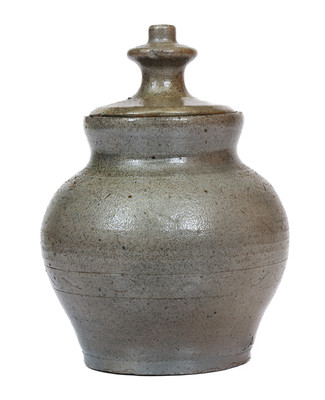
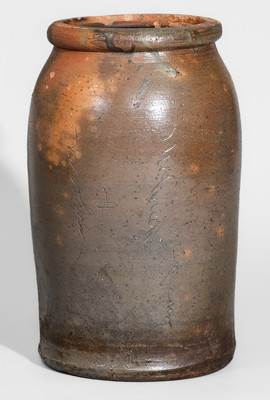
Extremely Rare Small-Sized Cobalt-Decorated Stoneware Jar, Inscribed "Byard Harris" and "Mohawk Pottery Co / Mohawk," Greene County, TN origin, circa 1887-1900, ovoid jar with tooled shoulder and semi-rounded rim, brush-decorated around the body with an undulating vine below a stripe. Midsection incised "Byard Harris." Underside incised "Mohawk Pottery Co / Mohawk." This specific jar is discussed in Smith and Rogers,Tennessee Potteries, Pots, and Potters - 1790s to 1950, Vol. 1, p. 116 as follows: "One of the more confused issues concerning potters in Mohawk begins with the previously mentioned comments of a long time resident. After the discussions concerning Haun, Weaver, and Lotspeich, there is the statement 'A man from Ohio by the name of Harris established a pottery plant here in about 1899, and manufactured drainage tile for about four years.' Nothing more has been learned about a Harris from Ohio, and it does not appear the operation described produced 'pottery.' However, there is a cobalt decorated crock in a private collection that is marked on its side with the name 'Byard Harris' and on the bottom 'Mohawk Pottery Co Mohawk.' The closest match for the Harris name appears to be 'Boyed Harris,' listed as an 18 year old laborer in the Mohawk civil district on the 1900 census. In 1900 he lived with his father, Walling Harris, and all members of the family are shown as born in Tennessee. There may or may not be any connection between all of this and the fact that a John M. Harris was the local postmaster from 1893-1895. The name 'Mohawk Pottery Co.' has not been seen in any other records, perhaps suggesting another operation in Mohawk that is still not well defined." Two newly discovered references to the Mohawk Pottery—the pictured advertisement and affidavit—help shed new light on this somewhat mysterious enterprise. A particularly fine example of Greene County stoneware, made extraordinary by its lavish cobalt, small size, and two inscriptions. Exhibited: Tennessee Turned, Earthenware and Stoneware Made in East Tennessee 1800-1900, Museum of East Tennessee History, May 16-October 30, 2011. Literature: Illustrated in Wahler, Tennessee Turned, Earthenware and Stoneware Made in East Tennessee 1800-1900, Part One, p. 74, fig. 76, p. 176, pl. 26, and p. 202, fig. 76. Provenance: Purchased from Monty Young. A 7/8" in-the-firing flake to underside, which leaves part of the "Moh" in the second "Mohawk" missing. A 2 1/2" hairline from rim. A minor in-the-firing base nick. Interior of rim with a small chip and minor nicks. H 4 5/8".