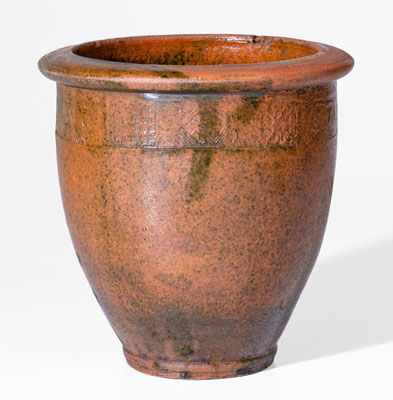
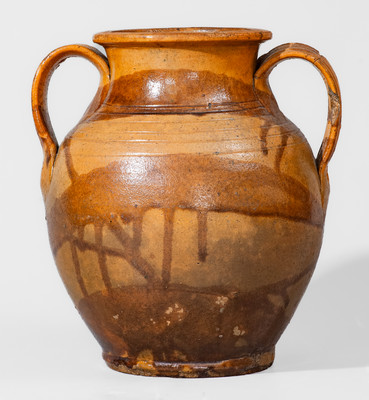
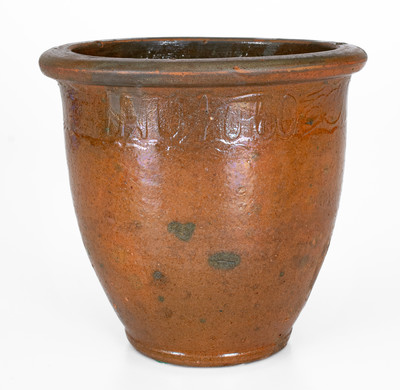
Exceptional Glazed Redware Jar with Amber-Colored Decoration, Stamped "C A HAUN & CO NO 1," Christopher Alexander Haun, Greene County, TN, circa 1840-1860, small-sized, bulbous jar with tooled foot and flattened, semi-rounded rim, brush-decorated around the midsection with a wavy, amber-colored band including appealing thin runs descending from it, applied under a clear lead glaze. The jar's unusually-colored decoration is likely achieved through a light concentration of iron oxide. Shoulder coggled with the repeating raised-face maker's mark, "C.A. HAUN & CO NO 1," described by Wahler as being the "clearest C.A. HAUN coggle impression to date." Christopher Alexander Haun (1821-1861) was a Union sympathizer during the Civil War who, on November 8, 1861, participated in the burning of a Confederate railroad bridge along Lick Creek in Greene County, Tennessee. A plan to burn nine bridges had been devised by local minister, Reverend William Blount Carter, and was supported by President Lincoln, with the promise that a Union regiment would be provided to protect those involved. However, Haun, along with four other Union loyalist potters, were later captured, convicted of treason, and hung by the Confederacy. A moving letter written by Haun to his wife, Elizabeth, while imprisoned before his hanging, asked her to "have Bohanan, Hinshaw or Low to finish off that ware and do the best you can with it for your support." Haun is regarded today as Tennessee's most gifted potter and revered as a man of principle who died for the Union cause. This jar is distinguished by its desirable spice-jar-style form, excellent condition, dynamic glaze, and unusually strong impression of Haun's maker's mark, rarely-seen in this potter's work. Exhibited: Tennessee Turned, Earthenware and Stoneware Made in East Tennessee 1800-1900, Museum of East Tennessee History, May 16-October 30, 2011. Literature: Illustrated in Wahler, Tennessee Turned, Earthenware and Stoneware Made in East Tennessee 1800-1900, Part One, p. 50 fig. 39, p. 90, pl. 12, p. 118, pl. 16., and p. 195, fig. 39. (See p. 195 for Wahler's note about this jar having the "clearest C. A. HAUN ... impression to date.") Provenance: Found in Morristown, Hamblen County, TN. Excellent condition with light wear. H 6 7/8".