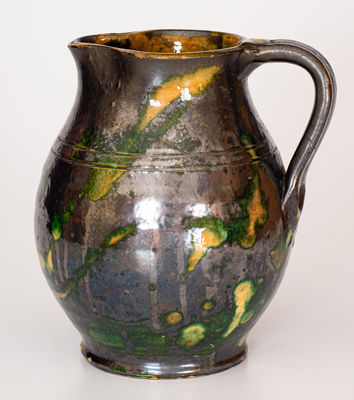
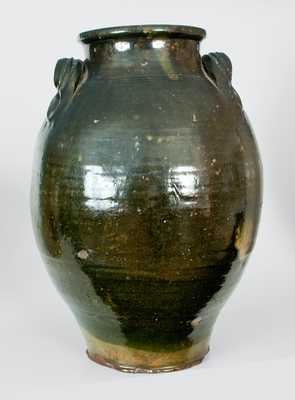
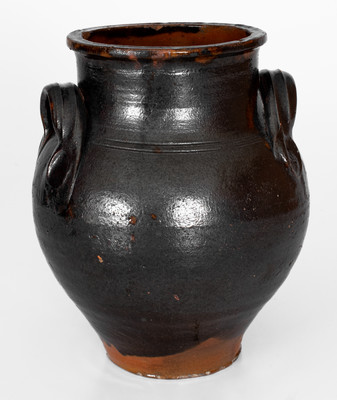
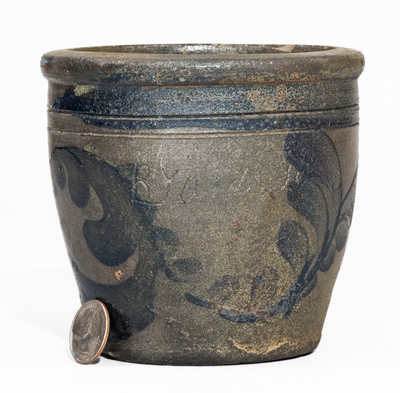
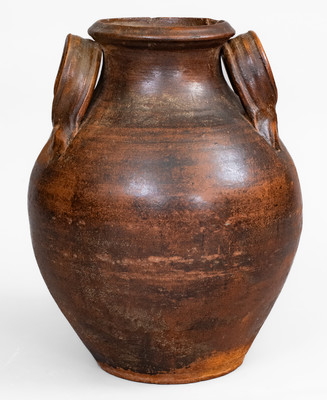
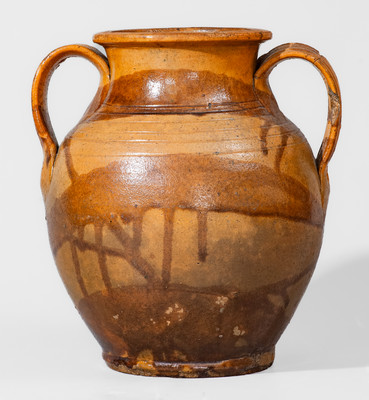
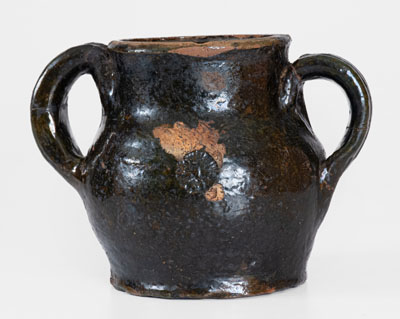
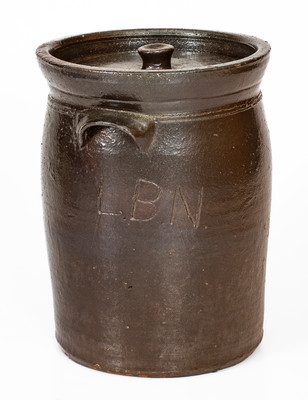
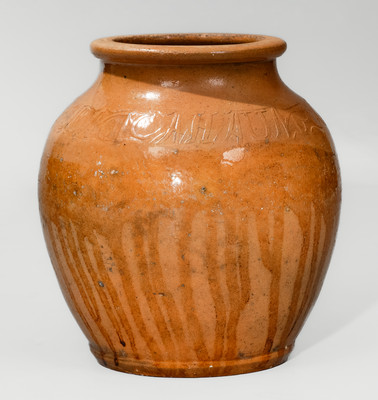
Rare Glazed Redware Jar with Crosshatched Copper-Slip Decoration, attributed to the C.A. Haun Pottery, Greene County, TN, circa 1840-1860, ovoid jar with footed base, tall collar with semi-rounded rim, and applied strap handles with impressed geometric and floral motifs at the terminals, the shoulder decorated with a coggled band of stylized foliate and geometric devices. Surface lavishly-decorated with brushed copper slip in a crosshatched pattern extending from the rim to the base and around the sides, including the handles, applied under a clear lead glaze. Christopher Alexander Haun (1821-1861) was a Union sympathizer during the Civil War who, on November 8, 1861, participated in the burning of a Confederate railroad bridge along Lick Creek in Greene County, Tennessee. A plan to burn nine bridges had been devised by local minister, Reverend William Blount Carter, and was supported by President Lincoln, with the promise that a Union regiment would be provided to protect those involved. However, Haun, along with four other Union loyalist potters, were later captured, convicted of treason, and hung by the Confederacy. A moving letter written by Haun to his wife, Elizabeth, while imprisoned before his hanging, asked her to "have Bohanan, Hinshaw or Low to finish off that ware and do the best you can with it for your support." A figure of both artistic and historical significance, Haun carries a two-fold legacy, regarded today as the state's most gifted potter and a man of principle who died for the Union cause. This work, considered one of the most extravagantly-decorated Tennessee redware jars known, showcases the brilliance of this potter. In her notes, Wahler states that the "[t]erminal stamps have been found on sherds from the J.A. Lowe site" further highlighting influence between Haun and Lowe. Exhibited: Tennessee Turned, Earthenware and Stoneware Made in East Tennessee 1800-1900, Museum of East Tennessee History, May 16-October 30, 2011. Literature: Illustrated in Great Road Style: The Decorative Arts Legacy of Southwest Virginia & Northeast Tennessee, p. 137. Illustrated in Wahler, Tennessee Turned, Earthenware and Stoneware Made in East Tennessee 1800-1900, Part One, p. 63, fig. 58, p. 83, pl. 5, p. 199, fig. 58, and p. 229, pl. 5. Provenance: Purchased at an estate sale in Fountain City, Knox County, TN. Restored by Meg Craft in Baltimore in 1985. Professional restoration to sporadic flaking, primarily to one side and below one handle. Some additional surface wear. Unrestored wear to rim and handle edges. Heavy exfoliation to interior. H 13".