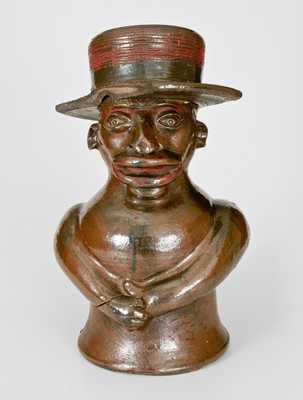
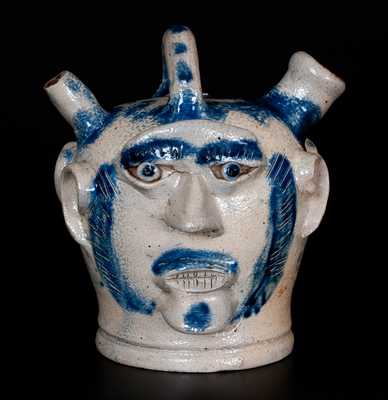
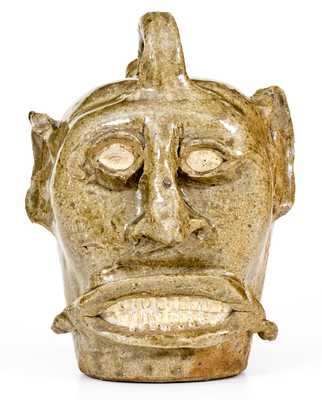
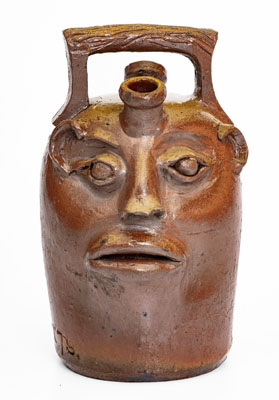
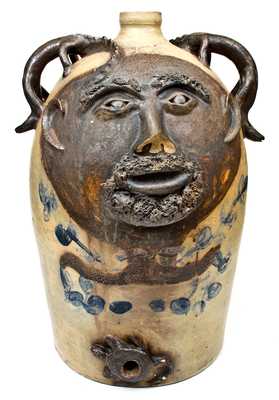
Highly Important Cobalt-Decorated Stoneware Face Jug with Incised Fish and Bird Motifs, attributed to David Parr, Jr., Baltimore, MD, circa 1835, cylindrical jug with tooled spout, decorated with a hand-modeled and applied clay face including a rounded forehead, heavily-incised eyebrows, mustache, and beard, and open mouth with incised teeth. Top and reverse of jug with heavily-incised hair. Reverse with heavily-incised decorations of a fish and bird, each paired with a sprig motif. Salt-glazed surface with profuse cobalt highlights throughout. Among the most extravagantly-detailed stoneware face vessels known, this work is distinguished by its prolific use of incising as a decorative treatment. Its incorporation of incised fish and bird designs are otherwise unknown to us in American face vessel production, creating an object of extraordinary decorative value. Adding such designs in essence creates two remarkable ceramic pieces in one jug, one viewable from the front and the other viewable from the back. The distinctive style in which these designs are executed leads us to an attribution to David Parr, Jr., relating it to the iconic "David Parr Manufactory / Geo. N. Fulton" incised eagle cooler as well as a Baltimore redware jug with incised bird motif, inscribed "look this way for Henry Clay." All three of these pieces have a similar quality to the incising. Referred to by Wahler as "Heinrich," this jug's manufacture in Baltimore circa 1835 places it at an exceptionally early period of production in the American South, making it possibly the earliest documented stoneware face vessel made below the Mason Dixon Line. The reexamination of this work adds tantalizing evidence for the influence of Baltimore on face vessel production further south. Provenance: Originally found at a storage locker auction in the Baltimore area. Missing handle. Proper right eye lost during the firing. Chipping to ears. Tight cracks in underside extending partway up body of jug. H 10 1/4".