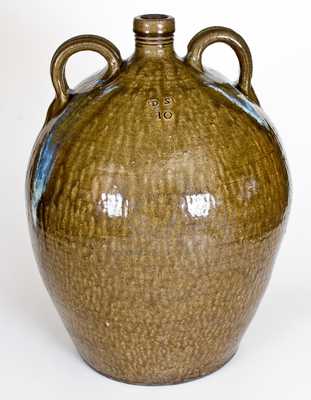
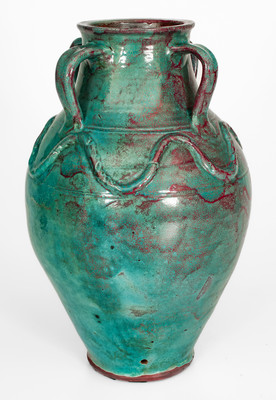
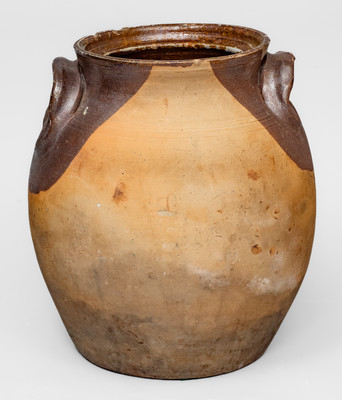
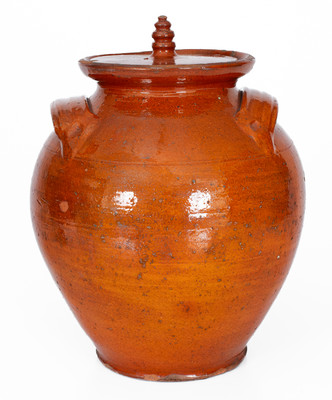
Fine Glazed Redware Jar, NC or Eastern TN origin, circa 1790-1860, ovoid jar with footed base, tooled shoulder, tall collar with flattened rim, and ribbed open-strap handles with depressed terminals, the surface covered in a mottled brown lead-based glaze colored with iron or manganese. This jar is attributed by Wahler to Christopher Alexander Haun of Greene County, Tennessee, circa 1840-1860, and is described as such in her book, Tennessee Turned. However, a closely-related jar in the collection of Old Salem Museum and Gardens in Winston-Salem, NC is attributed to Salem or Bethabara potteries, possibly Moravian, circa 1790-1820. This North Carolina attribution seems more likely, based on nuances of the form and glaze. A particularly well-potted vessel with mirror-like gloss to the glaze. Exhibited: Tennessee Turned, Earthenware and Stoneware Made in East Tennessee 1800-1900, Museum of East Tennessee History, May 16-October 30, 2011. Illustrated in Wahler, Tennessee Turned, Earthenware and Stoneware Made in East Tennessee 1800-1900, Part One, p. 71, fig. 71, p. 116, pl. 14, p. 201, fig. 71, and p. 230, pl. 14. Provenance: Purchased at David Elkins Auction, Bowmantown, TN on September 9, 1988. Exceptional condition for jars of this type with generally minor flaws: a 3 1/2" hairline from rim, a 1 1/2" glazed-over base chip, some additional shallow chipping and wear to base, a tiny glaze flake to one handle, a 5/8" rim chip, an adhered piece of in-the-firing clay to each side (contact mark), and a few minor surface-level fissures to glaze at shoulder. H 14".