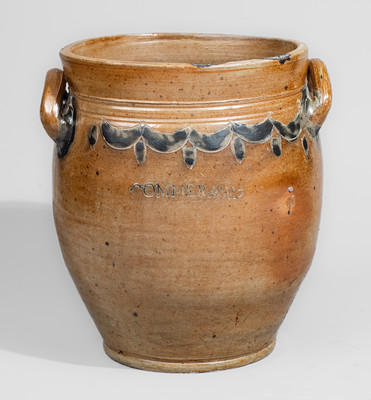
Extremely Rare and Important Stoneware Jar with Profuse Incised Floral Decoration, Stamped "COERLEARS HOOK / N. YORK," Thomas W. Commeraw, Manhattan, NY, late 18th century, approximately one-gallon, ovoid jar with heavily-tooled shoulder, footed base, and applied vertical handles, both sides decorated with a large and crisply-incised design of a fanned flower blossom extending from a leafy stem. Incised decorations delicately filled with vibrant cobalt slip. Collar impressed with the cobalt-highlighted signature "COERLEARS HOOK" on one side and "N. YORK" on the opposite side. Cobalt highlights to handle terminals. This jar is one of a small number of important pieces known bearing the earliest impressed Manhattan maker's mark known, "COERLEARS HOOK," which was employed during Thomas Commeraw's first years as an independent potter, beginning in 1796 or 1797. (Note the specific spelling here, versus the later "CORLEARS HOOK" stamp, used contemporaneously with the potter's "COMMERAW'S STONEWARE" mark. This earlier "COERLEARS HOOK" mark predates Commeraw's use of his own name on his work.) The few "COERLEARS HOOK" examples known feature exceptionally well-executed incised designs, which often rival the work of Commeraw's contemporaries, Clarkson Crolius, Sr. and John Remmey III. Moreover, the color and even glazing of these early jars often show a sophistication in firing, which excels beyond most extant Crolius and Remmey examples. A uniformity of style and potting ability seen among them suggests that this group alone can be said to be the work of the hands of Thomas Commeraw alone, versus later objects that appear to have been made within a multi-handed workshop. The jar offered here is one of the finest decorated and most attractively colored of surviving "COERLEARS HOOK" pieces, so much so that it was specifically chosen by A. Brandt Zipp as a back cover image for Commeraw's Stoneware: The Life and Work of the First African American Pottery Owner. A similarly decorated jar is currently in the Remensnyder Collection at the Smithsonian Institution. Provenance: Crocker Farm, Inc., November 2, 2013, lot 8. Literature: Illustrated in Zipp, Commeraw's Stoneware ..., back cover and p. 63, fig. 3. Both handles are professionally restored. Professionally-restored Y-shaped crack extending from shoulder to underside. (This restoration does not touch the decoration.) Three very minor rim chips. Thin, sealed horizontal crack at base. Minor glazed-over base chip. H 9 1/2".