
The Lifetime American Ceramics Collection of
Carole Carpenter Wahler
Collector • Curator • Dealer • Scholar (1937-2023) |
January 21 - 30, 2026
Full Online Catalog | How to Bid | Order the Print Catalog
Our Winter 2026 auction, The Lifetime American Ceramics Collection of Carole Carpenter Wahler: Part Two, speaks to the legacy of one woman's lifelong passion for American ceramics. As an ambitious collector, Dr. Carole Carpenter Wahler (1937 - 2023) amassed a vast assemblage of seminal examples of American ceramics spanning the Southern states and beyond. In terms of depth, breadth, and quality, her collection has few rivals past or present. As a guest curator, Wahler established herself as the recognized authority on Tennessee stoneware and redware while drawing deserved national attention to the state's rich ceramic tradition. As a dealer, she was a pioneer in the field of American primitive antiques, becoming an early specialist in stoneware. And as a scholar, Carole Wahler's painstaking research has forever shaped our understanding of stoneware and redware, fleshed out in books, articles, and her landmark collection.
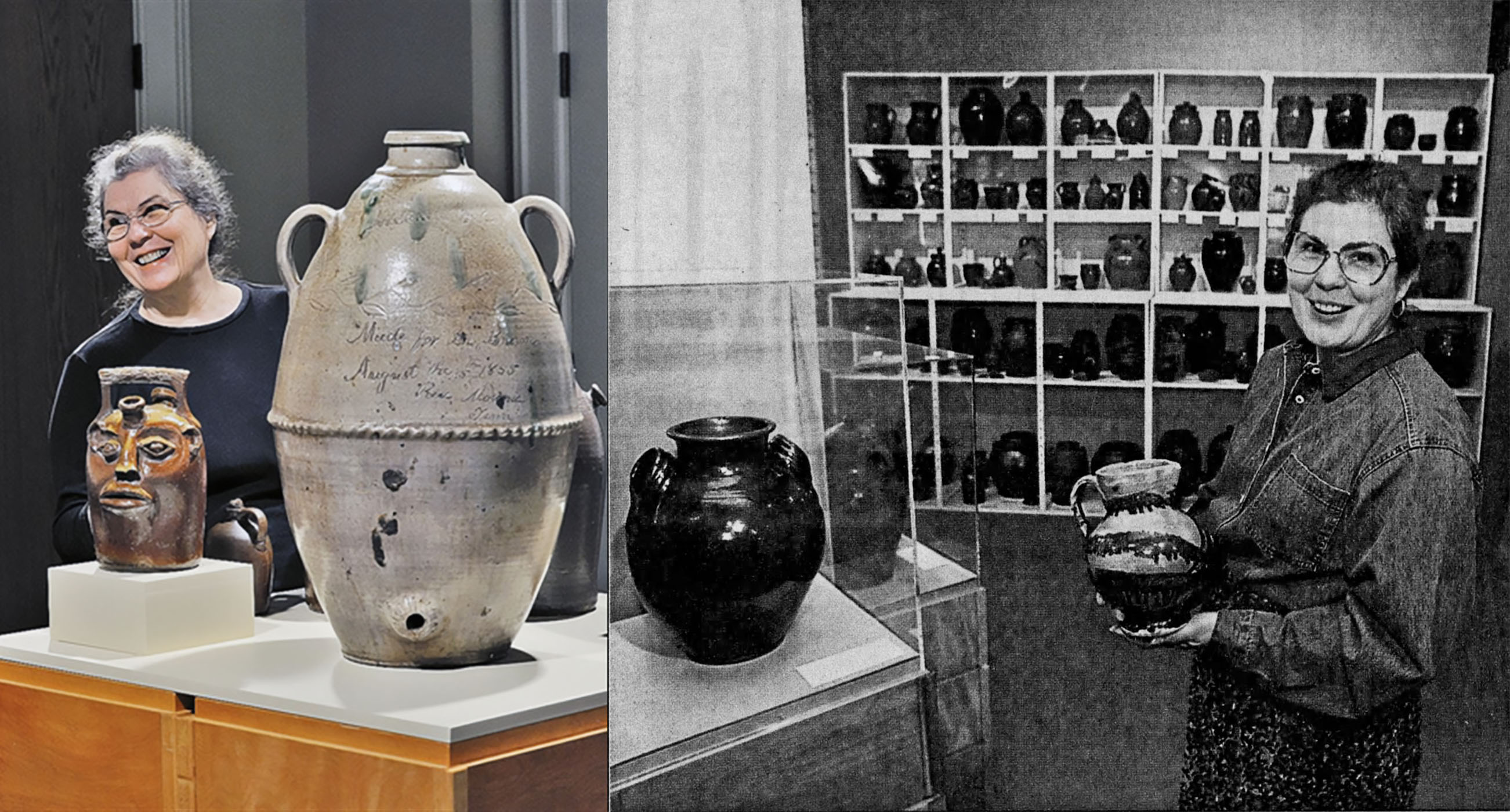
Carole Wahler at Tennessee Turned (2011) and Made by East Tennessee Hands: Pottery (1996), at the Museum of East Tennessee History.
Born and raised in New Mexico, pottery spoke to Carole Wahler from a young age as she collected sherds of Native American pottery in the desert. This curiosity turned into a passion for collecting, as she and her husband, Robert, purchased finer porcelain and Native American ceramics while still in graduate school in Washington State. After the Wahlers moved to Knoxville, TN in 1965 to begin their respective careers in psychology, Carole Wahler became a collector and part-time dealer. It was there that she quickly encountered American stoneware. Wahler purchased her first stoneware jar for fifty cents in 1964. Without fanfare, this purchase set her on the course to become a legendary figure in the field of American utilitarian ceramics.
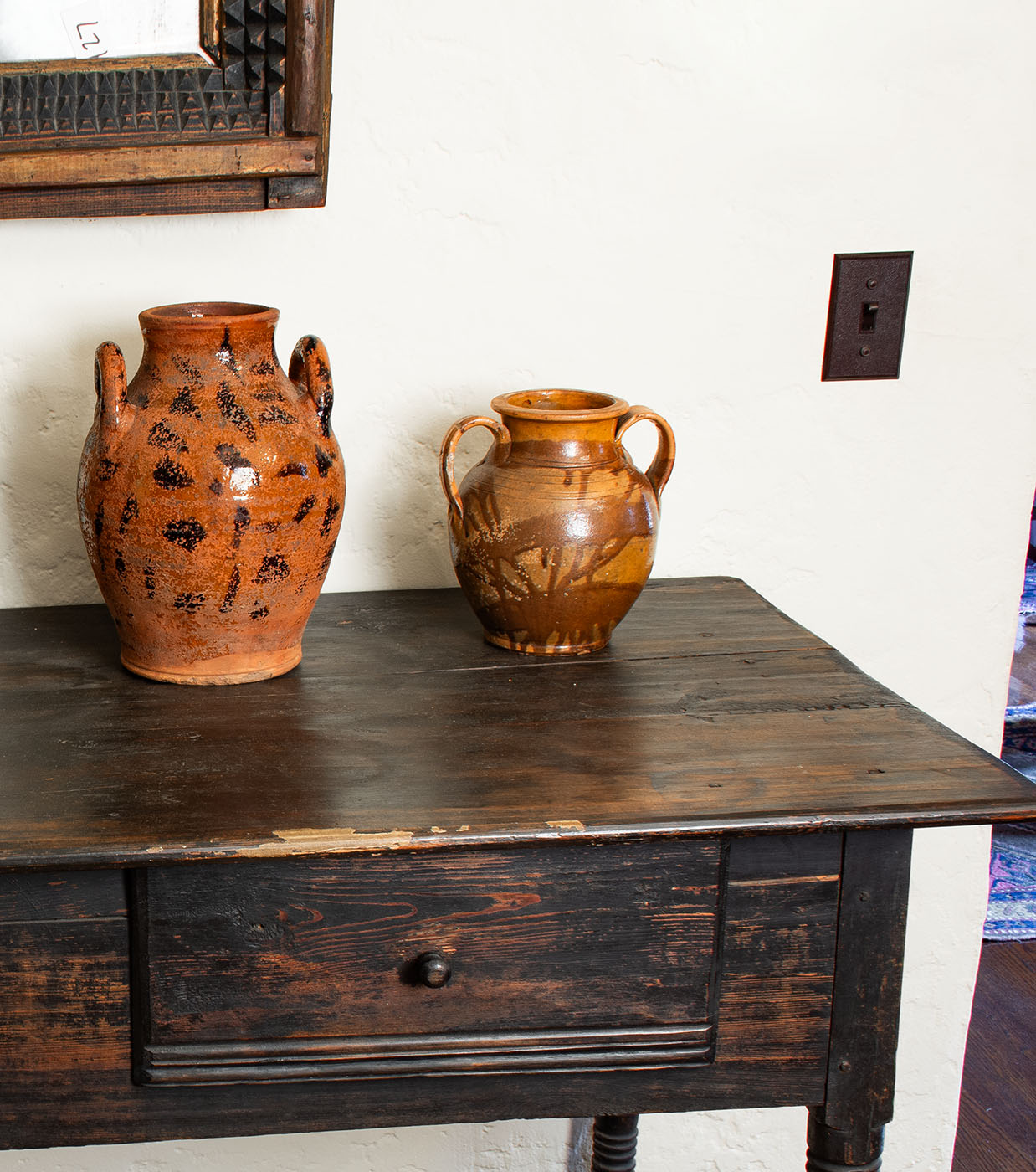
Two of Wahler's Tennessee redware jars, as she had them displayed in her home.
By 1971, Wahler purchased her first great piece of Tennessee stoneware, as she recorded, "off the top of the watermelon man's truck." During this time, she established herself as a full-time dealer, specializing in American primitive antiques, quickly listing "early decorated stoneware" as a primary focus. The stuff of legend, the Wahlers purchased an entire 1820's mid-Tennessee mountain town called Union Hill, a place Carole referred to as her "little Camelot." Situated on twenty-five acres near Livingston, TN, as Wahler's 1972 advertisement described, "Union Hill is an early settlement consisting of a Grist Mill, Country Store and log houses in Tennessee's Upper Cumberlands ... . ANTIQUES ON DISPLAY ARE PRIMARILY PRIMITIVE." Carole and Robert, along with their sons, Jeffrey and Robert, spent the first half of the 1970's splitting time between Knoxville and Union Hill until a 1976 sale of the historic town seemed regrettably logical. The real estate listing, "TOWN FOR SALE," attracted national attention, including a Washington Post article, which was subsequently picked up by newspapers as far away as Honolulu, HI.
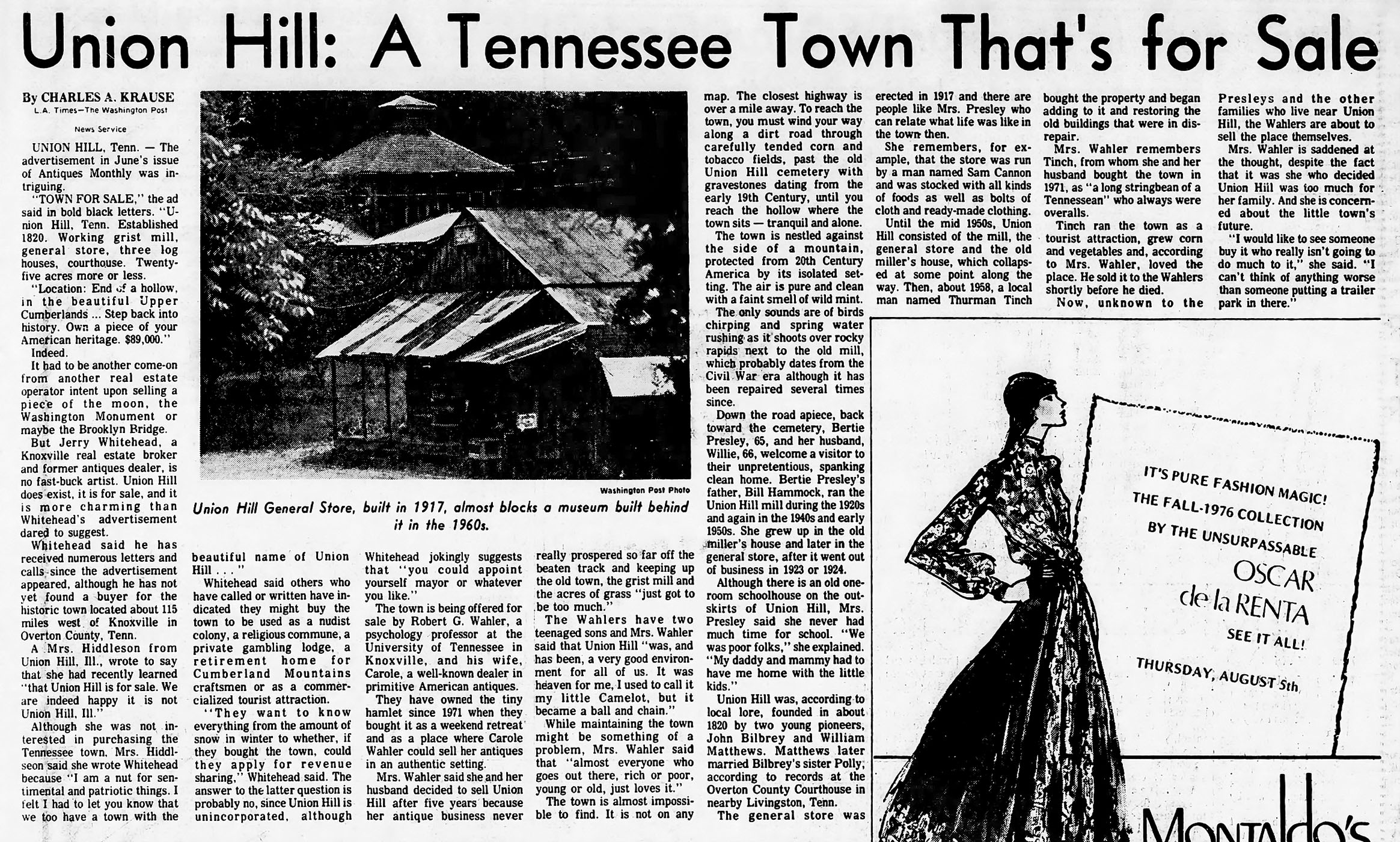
Article in the August 4, 1976 issue of the Winston-Salem Sentinel about Wahler's Union Hill.
As a collector and full-time dealer, Wahler's interest in Southern ceramics arrived at a time when peers were few and mentors were even fewer. She approached her collecting with a keen desire to glean every bit of knowledge a pot could offer. Wahler's words in an unsent letter to legendary collector and author Georgeanna Greer reveal her own collecting approach. In March 1990, after viewing the groundbreaking exhibition "Crossroads of Clay" at the McKissick Museum, a Texas pitcher loaned to the exhibit by Greer sparked Wahler's desire to reach out to her. As an introduction, she wrote, "I am Carole Wahler -- a pottery student, collector and sometimes dealer. I feel as though I know you through mutual acquaintances, papers you've delivered and, of course, your book. I hope that someday we will meet and talk pottery. For almost 20 years, I've been making my way knowledge-wise through Virginia, N. and S. Carolina, N. Georgia, and am currently inclined to focus on Northern Alabama. However, since it's rather like a giant puzzle, I seem to jump from area to area in what appears to be a haphazard fashion, assimilating the information a fact at a time." While ceramics scholars today can relate to the "giant puzzle" metaphor, Wahler began her love for researching pottery before most groundbreaking works had laid an adequate foundation. The breadth of her collection reads like a book attempting to document the story of the potter's craft in the American South. And the insides of her jars contain correspondences with other scholars, professional and amateur, attempting to assemble the same giant puzzle.
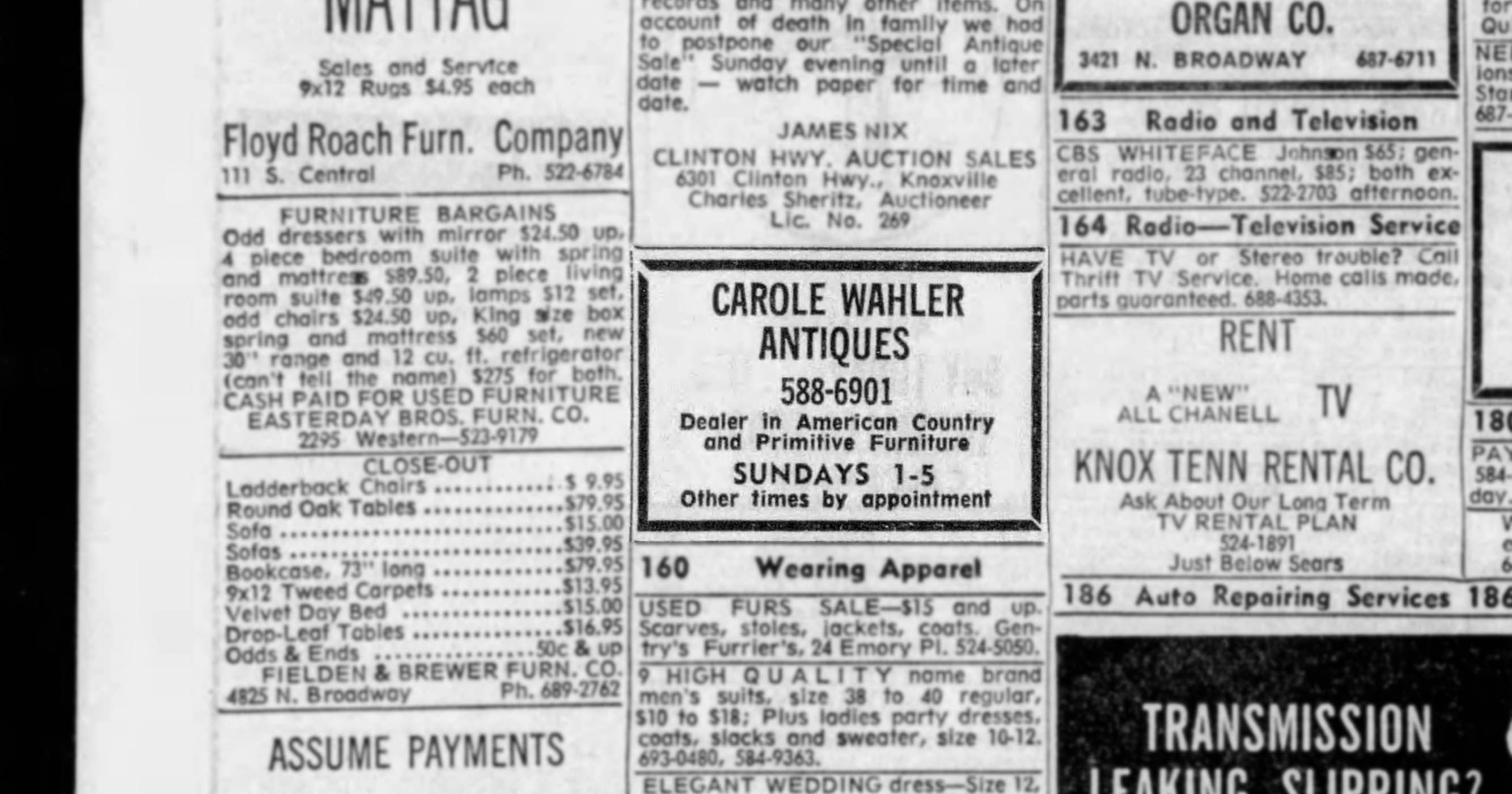
Ad for Carole Wahler Antiques in the Classified section of the Jan. 23, 1972 issue of The Knoxville News-Sentinel.
Three large metal filing cabinets lined her basement wall, filled with decades of useful primary, secondary, and anecdotal evidence regarding potters' identities. From all accounts of friends and family, these cabinets and the myriad manila folders inside them were as prized to Wahler as the trove of important pottery she collected over fifty years. While Wahler made her way through the Southern ceramic landscape, collecting significant objects and information along the way, her most lasting contribution as a scholar came in the rich ceramic history of her home state of Tennessee.
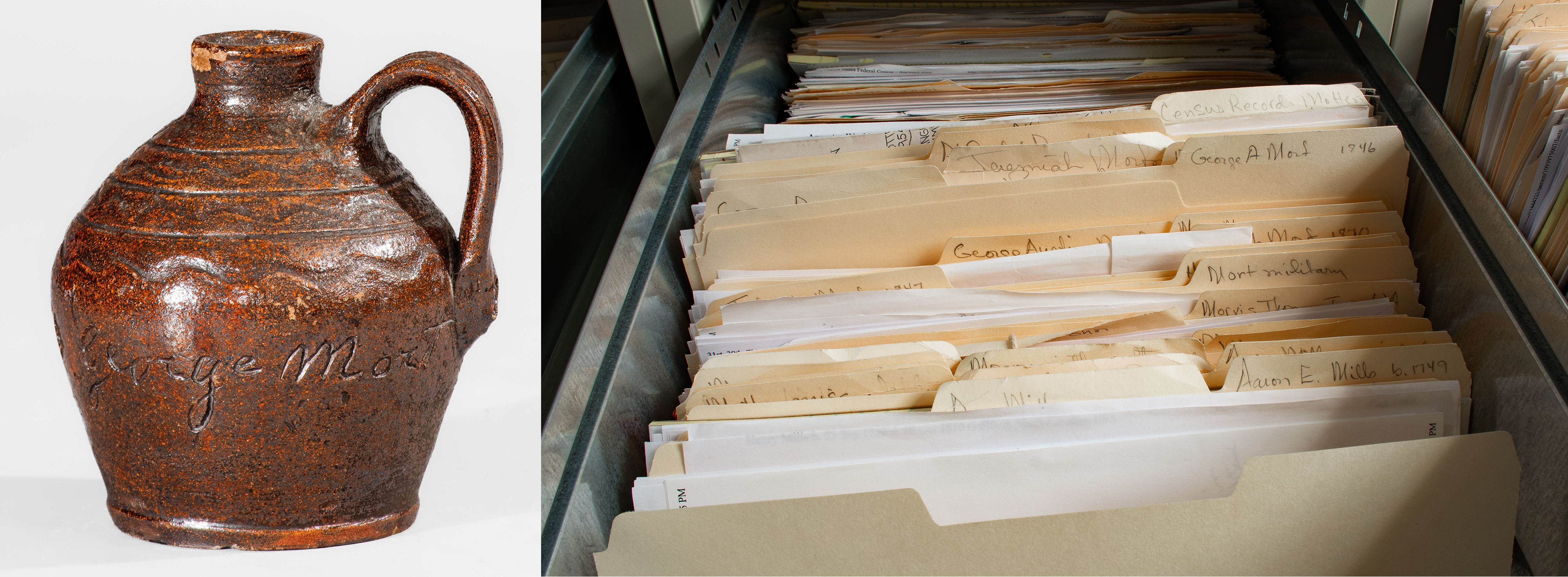
Wahler's important "George Mort" (Jefferson County, TN) jug, next to a photo showing her file on him.
She began amassing a documentary collection of Tennessee stoneware in 1975 and Tennessee earthenware in 1980, filling her cupboards with iconic examples of locally made pottery. From private homes to major dealers and auctions, Wahler purchased significant ceramic objects from all levels of the marketplace in an attempt to flesh out the state's pottery-making tradition. Ahead of her time, she located one of Tennessee's iconic surviving stoneware examples in 1984 at Garth's Auction in Delaware, OH. This object, bearing the signature of John Floyd in Knox County, TN, and sold in our Winter 2025 auction, helped expand public understanding of the high-quality stoneware produced in Tennessee. Wahler later acquired the equally iconic Floyd cooler featured in our Winter 2026 auction, and as a pair these became a cornerstone of her collection. In 2008, Wahler established a new world auction record for Tennessee pottery by acquiring the legendary J. A. Lowe handled redware jar at Case Auction in Knoxville, and this record was fittingly broken by Wahler's own Frederick Douglass face jug when it sold in our Winter 2025 auction. New high water marks like these made national headlines and have drawn deserved attention to Tennessee pottery, a goal Wahler constantly worked toward.
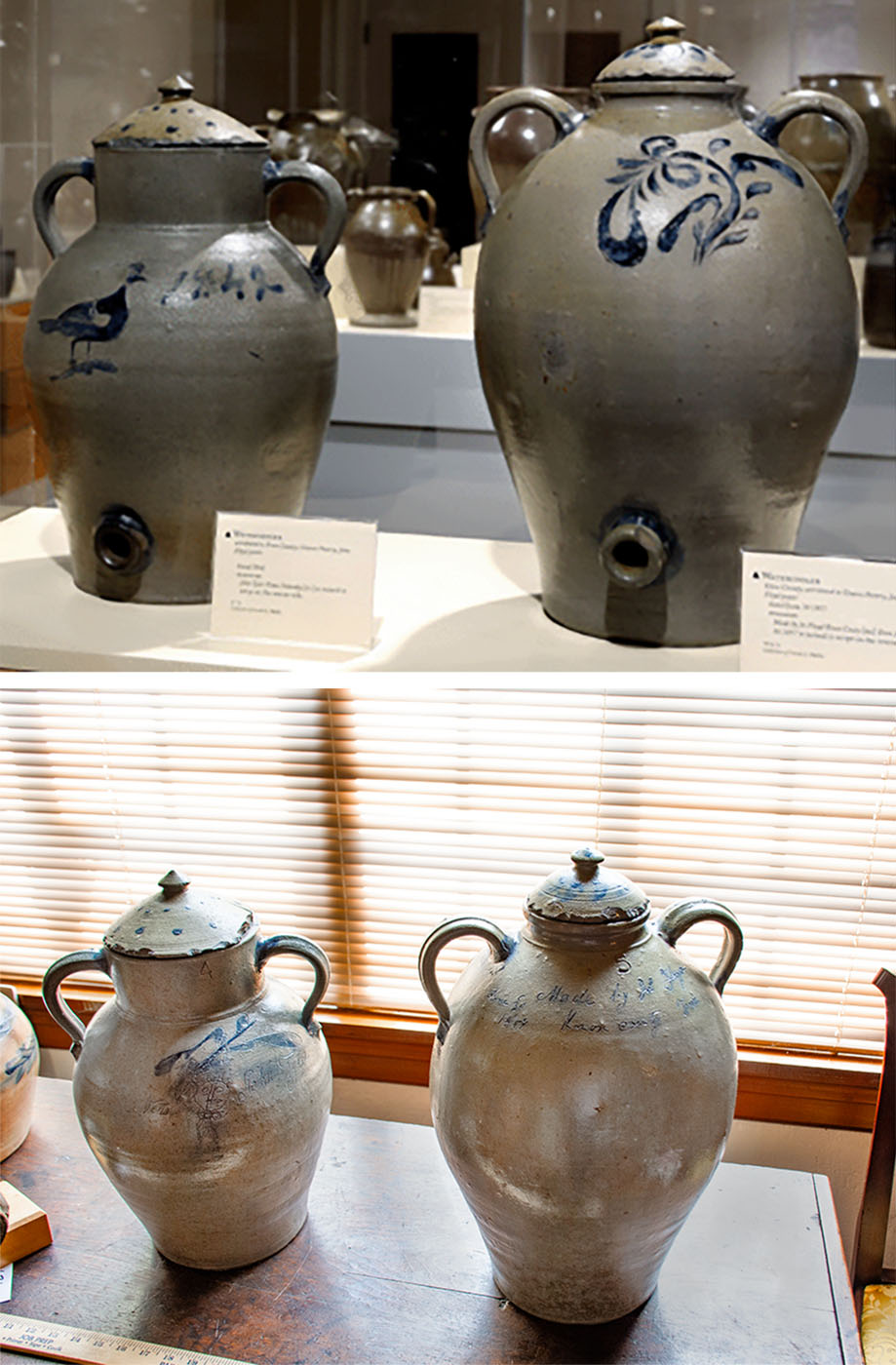
Wahler's iconic John Floyd stoneware coolers, at Tennessee Turned and in her home.
Perhaps inspired by Georgeanna Greer, Wahler loaned her Tennessee pottery widely to museum exhibitions, notably "Slipped and Glazed: Regional American Redware" at the Heritage Plantation of Sandwich, MA, in 1991 and "Art of Tennessee" at the Frist Center for the Visual Arts in 2004. Additionally, she served as guest curator for three landmark exhibitions at Knoxville, TN museums, each serving as new high-water marks of public enthusiasm and understanding of Tennessee pottery. The 1986 exhibition "Handed Down: A Sampling of East Tennessee's Folk Heritage" at the Dulin Gallery of Art in Knoxville, TN, was Wahler's response to the lack of Tennessee representation in other Southern ceramic exhibitions. While "Handed Down" contained other Tennessee material culture, Wahler noted that the state's pottery absolutely stole the show. She set to work on the first major exhibition of Tennessee pottery, "Made by East Tennessee Hands: Pottery," which ran from 1996 to 1997 at the Museum of East Tennessee History. This ambitious first effort set the stage for Wahler's most lasting legacy, the 2011 exhibition "Tennessee Turned: Earthenware and Stoneware Made in East Tennessee 1800-1900" at The East Tennessee Historical Society in Knoxville. She assembled and studiously cataloged the most impressive selection of Tennessee pottery ever displayed in one gallery, consisting of 331 objects from roughly 40 public and private individuals. Wahler was by far the largest lender. At the time, Wahler owned 133 items in the exhibition but acquired significant objects from other lenders after the fact. "Tennessee Turned" received national praise and attention and Wahler immediately began working on a print catalog for this ambitious effort.
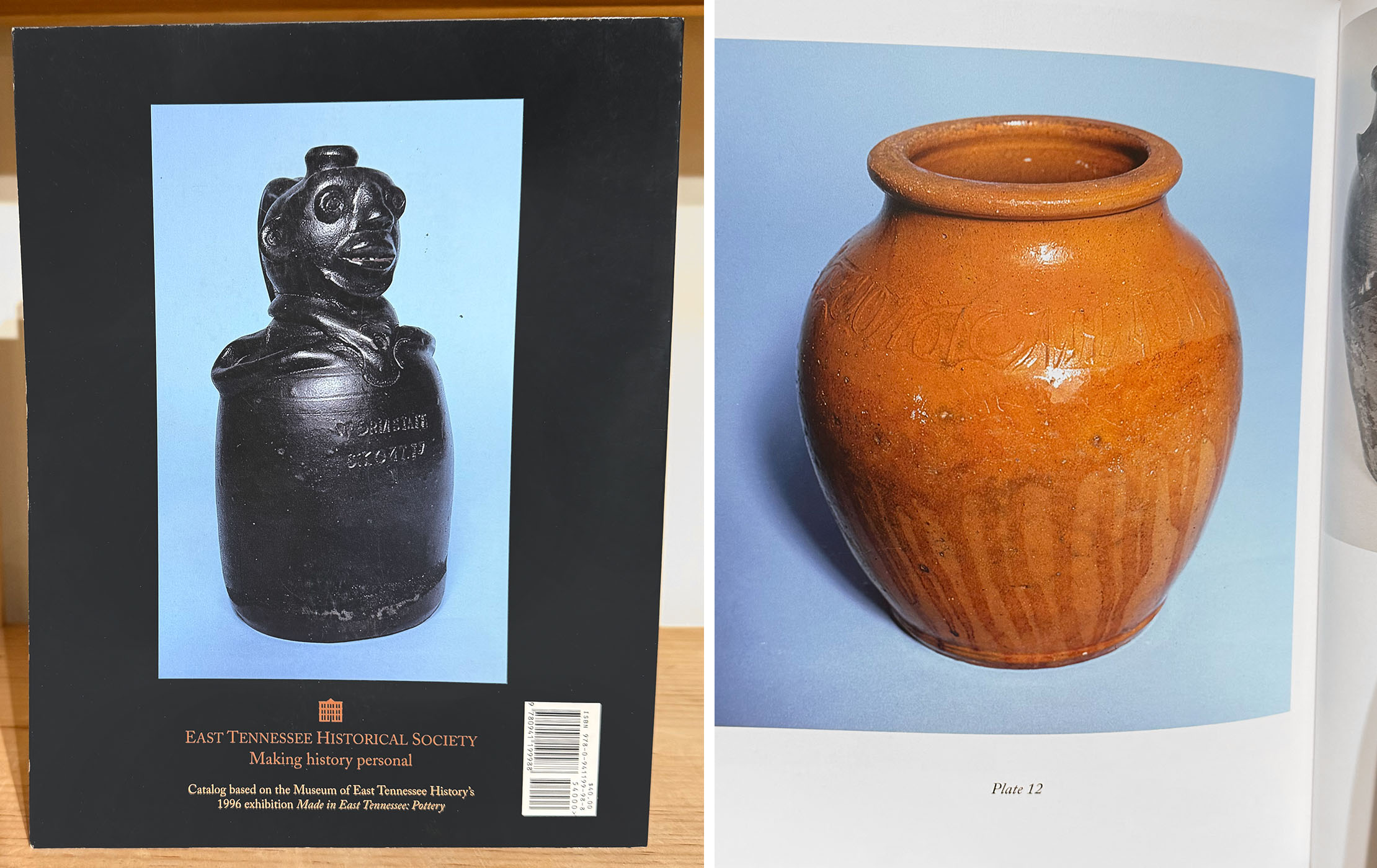
From Tennessee Turned: The back cover, featuring Lot 1 in our Winter 2026 sale, along with a page displaying Wahler's remarkably impressed "C.A. HAUN" redware jar (Lot 39 in the same auction).
Tennessee Turned: Earthenware and Stoneware made in East Tennessee, 1800-1900 -- Part One was at last published several months after her passing and now serves as the authoritative resource for East Tennessee's rich ceramic tradition. The descriptions and detailed research notes within it highlight Carole Wahler's expertise and focused attention to detail, as did the shelves in her home. Wahler curated her important collection with a hard-fought knack for recognizing rare opportunities in the marketplace. She loved collecting rare, often singular, signed examples that served as keys for attributing larger bodies of work. She pursued rare forms, notably acquiring face vessels well before their boom in the marketplace. And she loved acquiring important objects from legendary collections. The names of significant pioneer collectors fill Wahler's personal object database including Tony and Marie Shank, Pria Harmon, Terry and Stephen Ferrell, John Burrison, Howard Smith, Marcus King, Roddy Moore, Mary Jo Case, and Georgeanna Greer. Wahler's unsent letter to Greer highlights her own desire to acquire rare opportunities from important collections. She continued, "Today, I spent four hours studying the examples in the McKissick exhibit. It was great! I learned about potters I'd never heard of and identified some pieces I've had for years. It was a treat to see your Owenby jug in the real. I've always told my husband if I could pick just one of Georgeanna's Southern pieces it would probably be that jug. However, the piece that stopped me in my tracks was your Leopard pitcher made in TX. I recognized it immediately from your book, but had no idea its glaze was so spectacular! ... Georgeanna, if I look long enough and plan to trade high enough might I hope to find such a piece?"
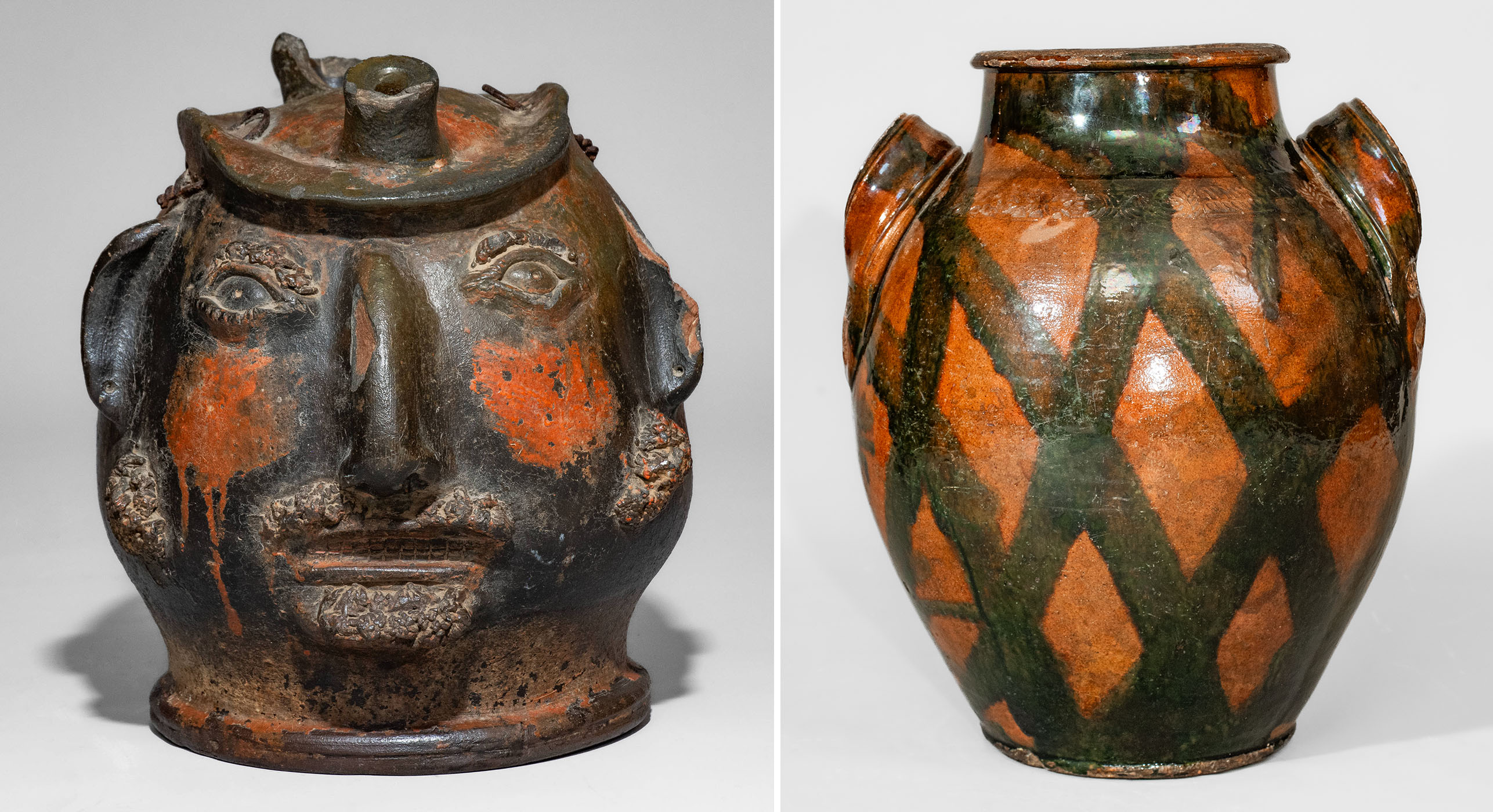
Stoneware and redware cornerstones of Wahler's collection: Her "Wm. Decker" face jug and crosshatched Haun jar.
Like Wahler's own collection, featured as single-owner Crocker Farm auctions in Winter 2025 and 2026, the Georgeanna H. Greer Stoneware Collection sold in two auction sessions (at Harmer Rooke Galleries in New York City, held November 1992 and January 1993). With the Lifetime American Ceramics Collection of Carole Carpenter Wahler: Part One setting a new world auction record as the highest-grossing single-owner stoneware & redware auction of all time, the sale of Dr. Wahler's collection is the first to rival Greer's in terms of depth, breadth, and quality. We look forward to seeing Dr. Wahler's legacy further expand with this, our second and final single-owner auction of her collection. As we do so, we thank the Wahler family for entrusting us with representing that legacy; it has truly been an honor.